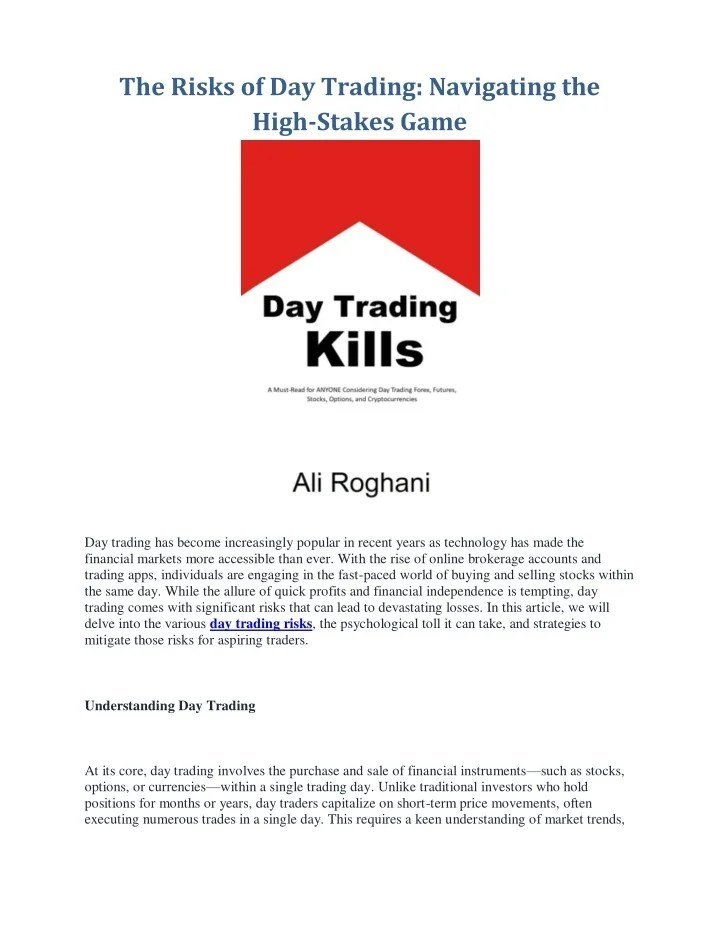
The siren song of quick profits and financial independence often leads aspiring traders down a path paved with high expectations: day trading. It’s a strategy where you buy and sell securities—be it stocks, currencies, or options—all within the confines of a single trading day, aiming to capitalize on minute-by-minute price swings and market volatility. This isn't your grandparent's "buy-and-hold" strategy; it's a high-octane sprint, not a marathon. But before you dive into the thrilling world of intraday trading, it's crucial to pull back the curtain and soberly assess the potential returns and financial risks of day trading.
For some, it's a captivating puzzle, offering an opportunity to sharpen market awareness and even complement more traditional, long-term investment strategies by exploiting short-term market inefficiencies. The allure is undeniable: the possibility of compounding returns rapidly within a single session, turning small gains into significant wealth. Yet, this high-octane pursuit comes with equally high stakes.
At a Glance: What You Need to Know About Day Trading
- Definition: Buying and selling securities within the same trading day to profit from short-term price movements.
- High Risk, High Reward: Offers the potential for rapid profits but carries substantial financial risks, including significant losses.
- Not a "Get Rich Quick" Scheme: Requires intense focus, rapid decision-making, extensive research, and disciplined execution.
- Demanding: Success hinges on deep market knowledge, advanced trading platforms, and strict risk management.
- Costs Add Up: High transaction fees and other costs can quickly erode profits.
- Emotional Rollercoaster: The pressure of constant decision-making and potential losses can lead to stress and poor judgment.
- Pattern Day Trader Rule: Typically requires a minimum of $25,000 in your brokerage account to avoid trading restrictions.
- Individual Odds: Finance experts like Robert Johnson note that individual investors face long odds, often underperforming simpler, long-term investment strategies.
The Allure vs. The Reality: Why Day Trading Captivates (and Often Disappoints)
Day trading is seductive. The vision of waking up, making a few smart moves, and logging off with a substantial profit before lunch is compelling. It suggests a level of control and immediate gratification rarely found in other investment avenues. For those who thrive on analysis and quick action, it can indeed be intellectually stimulating, a constant test of wits against the market's ever-shifting currents.
However, this picture often omits the relentless pressure, the emotional toll, and the stark reality that consistency is incredibly hard to achieve. Robert Johnson, a finance professor, aptly describes day trading as placing "numerous bets on short-term price moves." Each bet, while small, contributes to an overall strategy that demands near-perfect execution and an almost clairvoyant understanding of market dynamics. It's a game of inches, where every sliver of profit can be devoured by transaction costs, and every misstep can lead to painful losses.
The Potential Upside: How Returns Could Materialize
Let's be clear: the "potential returns" in day trading are significant, but they’re largely theoretical for most participants. Unlike long-term investing where you might aim for 7-10% annually, day traders often seek much smaller percentage gains—sometimes fractions of a percent—on a large volume of trades.
- Quick Compounding: The primary appeal is the ability to compound returns rapidly. If you can consistently make even a small percentage profit daily, that gain is added to your capital, allowing subsequent trades to be larger and, theoretically, yield larger absolute profits. A 0.5% gain on a $50,000 account is $250. If you repeat that every day, five days a week, that adds up quickly, isn't it?
- Capitalizing on Volatility: Day traders thrive on market volatility. When prices are swinging wildly, there are more opportunities to buy low and sell high (or vice-versa, in short selling) within a short timeframe. Events like earnings reports, economic data releases, or geopolitical news can create these rapid movements, offering a fertile ground for quick profits.
- Enhanced Market Awareness: Consistent exposure to the market's inner workings can lead to a profound understanding of how news, sentiment, and technical factors influence prices. This deeper insight can be a valuable skill, even if one ultimately transitions to other forms of trading or investing.
However, the chasm between potential and actual returns is vast. Consistently hitting those small percentage gains day after day, week after week, is the financial equivalent of catching lightning in a bottle. It demands not just skill, but an almost superhuman level of discipline and emotional control.
The Financial Risks You Can't Afford to Ignore
While the allure of quick gains is strong, the financial risks associated with day trading are substantial and multi-faceted. These aren't minor hurdles; they are fundamental challenges that can quickly decimate capital.
1. The Peril of Rapid Capital Loss
This is the most direct and brutal risk. In the blink of an eye, a position can move against you, leading to significant losses. Unlike long-term investors who can ride out market downturns, day traders operate on such tight timeframes that even minor adverse movements can trigger substantial drawdowns. Without strict risk management, a few bad trades can wipe out weeks or months of hard-won profits, or worse, your entire trading capital.
2. Substantial Trading Costs
Many aspiring day traders vastly underestimate the impact of transaction costs. Every buy and sell order incurs commissions, and if you’re making dozens or even hundreds of trades a day, these fees accumulate rapidly. Beyond commissions, you might also face:
- Bid-Ask Spreads: The difference between the highest price a buyer is willing to pay and the lowest price a seller is willing to accept. This spread is a built-in cost of liquidity.
- ECN Fees: Fees charged by Electronic Communication Networks for order routing, especially for aggressive orders.
- Data Subscriptions: Real-time data feeds, advanced charting, and news services are often essential tools, and they come with a price tag.
These costs chip away at every winning trade and exacerbate every losing one, making profitability an even steeper climb.
3. The Pattern Day Trader (PDT) Rule
For those trading in the U.S., the Financial Industry Regulatory Authority (FINRA) imposes the nuances of the Pattern Day Trader (PDT) rule. If you execute four or more day trades within five business days in a margin account, and these day trades represent more than 6% of your total trades for that period, you're labeled a "pattern day trader."
The catch? Pattern day traders must maintain a minimum equity of $25,000 in their brokerage account. If your account balance drops below this threshold, you cannot make any more day trades until you restore the balance. This rule can severely restrict trading activity, especially for undercapitalized traders, turning a series of small losses into a forced hiatus. While there's talk of a new FINRA rule change potentially eliminating this restriction, it remains a critical factor for now. Always check with your broker for their specific requirements.
4. Emotional Stress and Decision Fatigue
Day trading is an intense mental game. The constant need for rapid decision-making under pressure can lead to significant emotional stress. Fear of missing out (FOMO), greed, impatience, and revenge trading (trying to immediately recover losses) are powerful psychological biases that can derail even the most well-laid plans.
- Cognitive Overload: Processing real-time data, news, and technical indicators, then executing trades, can lead to decision fatigue.
- Impulsive Actions: When under stress, traders are more prone to straying from their strategy, taking impulsive trades, or holding onto losing positions for too long.
- Burnout: The sheer intensity can lead to burnout, impacting judgment and overall well-being.
5. Market Reversals and Unpredictable Events
The market is a dynamic beast. A stock can be soaring one minute and plummeting the next due to unforeseen news, a sudden shift in sentiment, or even a "flash crash." Day traders, by design, are highly exposed to these intraday reversals. Unlike long-term investors who might diversify across many assets and time horizons, a day trader's concentrated bets over short periods make them particularly vulnerable to these sudden shifts. Geopolitical events, unexpected economic announcements, or even a large institutional order can instantly invalidate a carefully constructed trading thesis.
The Day Trader's Toolkit: What It Takes to Even Try to Succeed
Given the immense challenges, success in day trading isn't a matter of luck; it's the culmination of rigorous preparation, continuous learning, and unwavering discipline. For those who choose to pursue this path, several critical components form the bedrock of any attempt at profitability.
1. Research and Analysis: The Homework Never Ends
Before any capital is put on the line, a day trader must conduct extensive research. This involves:
- Market Trends: Understanding broader market sentiment, sector performance, and economic indicators.
- News Scrutiny: Staying abreast of breaking news, earnings reports, analyst upgrades/downgrades, and company-specific announcements that can trigger price movements.
- Technical Analysis: Interpreting charts, patterns, and indicators (e.g., moving averages, RSI, MACD, volume) to identify potential entry and exit points.
- Fundamental Overlays: While less critical for intraday moves, a basic understanding of a company's fundamentals can inform a watchlist.
This isn't a one-time task; it's an ongoing commitment to staying informed and adaptable.
2. Crafting a Targeted Portfolio (Watchlist)
You can't trade everything. Effective day traders curate a focused watchlist of securities that exhibit the characteristics they need: sufficient liquidity, volatility, and often, a clear response to technical or news-based catalysts.
- Liquidity: Ensures you can enter and exit positions quickly without significantly impacting the price.
- Volatility: Provides the price swings necessary to generate profit opportunities.
- Favorable Risk-Reward Profiles: Identifying trades where the potential profit significantly outweighs the potential loss, crucial for long-term survival.
- Specific Entry/Exit Points: Pre-defining where you'll get in and where you'll cut losses or take profits, removing emotion from the decision.
3. Capital Allocation and Robust Risk Management
Perhaps the single most important aspect of day trading is robust risk management principles. This isn't just about minimizing losses; it's about protecting your trading capital so you can live to trade another day.
- Position Sizing: Never risking too much capital on a single trade. A common rule is to risk no more than 1-2% of your total trading capital per trade.
- Stop-Loss Orders: Automatically selling a security if it drops to a predetermined price, limiting potential losses. This is non-negotiable for day traders.
- Profit Targets: Defining where you will take profits, preventing greed from turning a winning trade into a loser.
- Max Daily Loss: Setting a hard limit on how much you're willing to lose in a single day, and then stepping away if that limit is hit.
- Understanding Leverage: Margin can amplify both gains and losses. Used irresponsibly, it's a fast track to ruin.
4. Sophisticated Trading Platforms
Executing trades with speed and precision requires a high-quality trading platform. You'll need access to choosing a broker with advanced features, including:
- Real-time Data: Up-to-the-second price quotes and market depth information.
- Advanced Charting Tools: Customizable charts with a wide array of technical indicators.
- Fast Order Execution: Minimal latency between placing an order and its execution.
- Direct Market Access (DMA): The ability to route orders directly to exchanges for faster execution.
- Hotkeys: Customizable keyboard shortcuts for ultra-fast order entry and cancellation.
Lagging data or slow execution can cost a day trader dearly.
5. Execution and Monitoring: The Dance with the Market
Once a plan is in place, it’s all about disciplined execution. This means:
- Sticking to the Plan: Resisting the urge to deviate from pre-defined entry, exit, and stop-loss points.
- Diligent Monitoring: Constantly watching positions, adjusting stop-losses (trailing stops), and being ready to act as market conditions evolve.
- Record Keeping: Maintaining a detailed trading journal to track trades, analyze performance, and identify patterns in successes and failures.
6. Adopting Proven Strategies
There isn't one "magic bullet" strategy. Successful day traders often employ a range of techniques tailored to specific market conditions or asset classes. Some of the most effective day trading strategies include:
- Momentum Trading: Buying stocks that are showing strong upward price movement and high volume, then selling as momentum starts to fade.
- Breakout Trading: Identifying securities that are breaking above resistance levels or below support levels with increased volume, expecting a continued move in that direction.
- Scalping: Making numerous small trades throughout the day to profit from tiny price changes, often holding positions for mere seconds or minutes.
- Reversal Trading: Identifying securities that have moved significantly in one direction and are showing signs of exhaustion, anticipating a reversal in price.
- News- or Event-Based Trading: Reacting quickly to breaking news or scheduled economic releases that are likely to cause sharp price movements.
Each strategy requires its own set of rules, indicators, and risk parameters.
7. Closing All Positions: No Overnight Holds
A fundamental tenet of day trading is to exit all positions before the market closes. This is done specifically to mitigate "overnight risk" – the risk that unforeseen news or events occurring after market close will cause a significant price gap when the market reopens, potentially wiping out gains or exacerbating losses without the ability to react. This discipline is what fundamentally differentiates day trading versus traditional investing.
Pitfalls & Misconceptions: What Most Newbies Get Wrong
The path to day trading is littered with common mistakes. Understanding these pitfalls can help you navigate the landscape more effectively.
The "Get Rich Quick" Delusion
This is arguably the most dangerous misconception. Day trading is often marketed as a fast track to wealth, but the reality is grueling. It requires immense effort, skill, and capital. Most individual day traders lose money, with studies suggesting that only a small percentage (often cited as 10% or less) achieve consistent profitability. It's a profession, not a lottery ticket.
Underestimating Trading Costs and Taxes
Beyond commissions, remember the capital gains tax. Short-term capital gains (on assets held for a year or less) are taxed at ordinary income rates, which are typically much higher than long-term capital gains rates. These tax implications can significantly reduce your net profits.
Neglecting Continuous Education and Adaptation
The markets are constantly evolving. Strategies that worked yesterday might fail tomorrow. Successful day traders are lifelong learners, constantly refining their approach, studying new indicators, and adapting to changing market conditions. Stagnation is a death sentence in this arena.
Trading Without a Detailed Plan
Impulse trading, or "revenge trading" after a loss, is a quick way to deplete capital. Every trade should be part of a well-defined plan, complete with entry, exit, and stop-loss points. If you can't articulate your reasons for entering a trade, you shouldn't be in it.
Is Day Trading Right for You? A Candid Self-Assessment
Given the rigorous demands and significant risks, day trading is emphatically not suitable for everyone. It requires a specific temperament, knowledge base, and financial standing.
Who Day Trading is NOT For:
- Those with a long-term investment horizon: If your goal is to save for retirement or a house down payment over many years, a "buy-and-hold" strategy, perhaps in low-cost index funds, will likely serve you far better and with significantly less stress. As Robert Johnson noted, individual investors often face long odds with day trading, and passive strategies can yield higher returns over time.
- Individuals with low risk tolerance: If losing money causes you significant distress or anxiety, day trading will be a miserable and likely unsuccessful endeavor.
- Those who cannot afford to lose their capital: Only trade with truly discretionary funds – money you can afford to lose entirely without impacting your financial stability.
- People lacking discipline and emotional control: The market will test your patience, temper, and resolve daily.
- Anyone seeking a "set it and forget it" investment: Day trading demands constant attention and active management.
Questions to Ask Yourself Before Considering Day Trading:
- Do you have sufficient capital (at least $25,000 in the U.S.) that you can afford to lose entirely?
- Are you disciplined enough to stick to a trading plan, even when fear or greed set in?
- Do you have the time (several hours a day) to dedicate to research, monitoring, and execution?
- Are you genuinely interested in learning complex market dynamics and technical analysis?
- Can you handle intense emotional pressure and remain rational after losses?
- Do you understand that the vast majority of day traders fail to achieve consistent profitability?
If you answered "no" to multiple of these questions, day trading is likely not the right path for you. There are many other effective ways to grow wealth, many of which involve far less stress and risk.
Your Next Steps: Proceed with Caution (and Knowledge)
If, after this candid assessment, you still feel drawn to day trading, the emphasis must shift from romanticized dreams to rigorous preparation.
- Educate Yourself Relentlessly: Read books, take reputable courses, and study successful traders. Understand market structure, technical indicators, and fundamental drivers.
- Start with a Demo Account: Almost all brokers offer paper trading accounts. This allows you to practice your strategies with simulated money in a real-time market environment, without any financial risk. Treat it as if it were real money to develop discipline.
- Develop a Detailed Trading Plan: Don't just trade randomly. Define your entry and exit rules, your risk management parameters (stop-losses, position sizing, max daily loss), and the specific strategies you will employ.
- Start Small: When you transition to real money, begin with the absolute minimum capital and position sizes possible. Focus on proving your strategy and discipline before scaling up.
- Prioritize Risk Management Above All Else: Never risk more than you can afford to lose on a single trade. Protect your capital fiercely.
- Maintain a Trading Journal: Document every trade, your rationale, your emotions, and the outcome. This is invaluable for learning and improving.
- Consider Professional Advice: Before allocating significant capital, consulting a fee-only financial advisor can provide an objective perspective on how day trading fits into your overall financial goals and risk profile.
Day trading offers the tantalizing prospect of rapid returns, but it's a field fraught with substantial financial and emotional risks. It's a challenging, demanding pursuit where consistency is rare and failure is common. Approach it with open eyes, a disciplined mind, and a healthy respect for the market's unforgiving nature. Your financial future depends on it.